


Peptide Storage and Stability: The Four Chemistries That Degrade a Peptide, and Why the Sequence Decides Which Ones Apply
The question I get by email more than any other is how long a reconstituted vial lasts in the fridge. There is no single answer, and the reason is more useful than a number would have been. Four separate chemical reactions destroy peptides, each one needs a specific amino acid to attack, and which reactions apply to your vial depends on what is in the sequence. Two peptides on the same shelf at the same temperature can be on completely different clocks.
Research-use-only disclaimer: Material supplied by PrymaLab is intended strictly for in-vitro and laboratory research use and is not intended for human or veterinary use in that context. This article covers laboratory handling and storage chemistry of reference material. It contains no dosing or administration guidance and nothing here is medical advice.

TL;DR
Four chemistries degrade peptides: oxidation, deamidation, hydrolysis and aggregation. Oxidation attacks methionine and cysteine. Deamidation attacks asparagine and glutamine. Hydrolysis and deamidation both consume water, which is the entire reason material ships lyophilised: remove the water and you suppress two of the four routes. Most peptides are most stable around pH 3 to 5, because deamidation accelerates above pH 5 through a succinimide intermediate. The sequence decides which reactions apply: BPC-157 has no methionine, cysteine or asparagine and therefore no obvious target for two of the four. Semax has methionine at position 1 and does. Research use only.
Oxidation: methionine to methionine sulfoxide. The most common degradation route.
Deamidation: asparagine to aspartate and isoaspartate, via a succinimide intermediate.
Hydrolysis: backbone cleavage. Needs water.
Aggregation: molecules associating and dropping out of solution.
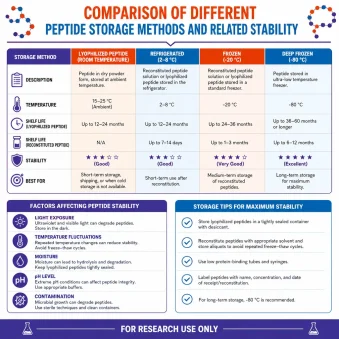
Lyophilisation works because it removes the water two of those four reactions require.
pH 3 to 5 is the stability window for most peptides.
The variable nobody checks: which residues the sequence actually contains.
Why the Fridge Question Has No Answer
"How long does reconstituted peptide last in the fridge" assumes peptides are one kind of thing with one storage clock. They are not. A peptide is a specific sequence of amino acids, and degradation reactions attack specific amino acids. Change the sequence and you change which reactions can happen at all.
Take three compounds from this catalogue.
BPC-157 is GEPPPGKPADDAGLV. Glycine, glutamate, proline, lysine, alanine, aspartate, leucine, valine. No methionine, no cysteine, no asparagine, no glutamine. Two of the four major degradation routes have nothing to attack.
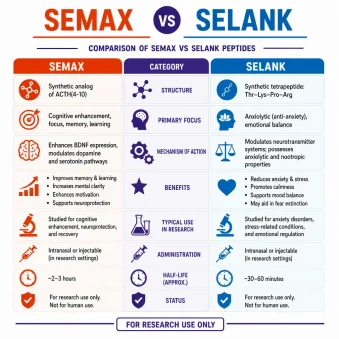
Semax is Met-Glu-His-Phe-Pro-Gly-Pro. Methionine sits at position 1, exposed at the N-terminus, and methionine oxidation is the single most common peptide degradation reaction.[1]
Oxytocin carries a disulfide bridge between two cysteines, and that bridge is required for activity. Disulfides can be reduced or scrambled, and neither event changes the molecular mass much, so a degraded oxytocin looks fine on a crude mass check.
Those three do not share a storage problem. Giving them one number would be giving two of them the wrong number.
Oxidation
Methionine oxidation converts a methionine residue to methionine sulfoxide by reaction with oxygen. It is the most common form of peptide degradation, and a large number of research peptides contain methionine, which makes it the central stability concern in this category.[1]
The chemistry is unglamorous. The sulfur in the methionine side chain picks up an oxygen atom. The mass increases by 16 daltons. The molecule is otherwise intact and may look normal by most quick checks, but the side chain is now polar where it used to be hydrophobic, and if that residue was involved in receptor binding, the activity is gone.
Cysteine oxidation is a related problem with a different outcome. Two cysteine thiols oxidise to form a disulfide bond, which is sometimes desirable and sometimes catastrophic depending on whether the bond forms in the intended place. Intramolecular disulfides that are supposed to exist can scramble. Free cysteines that were not supposed to bond can dimerise the peptide.
Things that accelerate it: dissolved oxygen, trace metal ions (copper and iron are the usual culprits), light, and elevated temperature. Things that slow it: low temperature, minimal headspace in the vial, protection from light, and avoiding metal contamination.
That copper point is worth connecting to something else in this catalogue. GHK-Cu is a copper complex, and blends like GLOW and KLOW put a redox-active metal in a vial with other peptides. Whether that matters depends entirely on whether the co-formulated peptides contain methionine or cysteine, which is the same sequence question this article opened with.
Deamidation
This is the reaction I find most interesting, partly because the mechanism is elegant and partly because the product is a molecule that weighs almost the same as the one you started with.
Deamidation converts asparagine to aspartate by hydrolysing the amide on the side chain.[2] Under neutral to alkaline conditions, roughly pH 5 to 12, it does not happen in one step. The backbone nitrogen attacks the side chain carbonyl and forms a five-membered ring called a succinimide intermediate, which then opens by hydrolysis.[2]
The ring can open two ways. One gives normal aspartate. The other gives isoaspartate, where the peptide backbone now runs through the side chain carboxyl instead of the alpha carboxyl. That inserts an extra methylene into the backbone and kinks the chain at that point.
The mass change from asparagine to aspartate is one dalton. Aspartate and isoaspartate are isomers and weigh exactly the same as each other. So a peptide can be substantially deamidated, partly isomerised, and structurally altered, while a mass spectrum shows something very close to the expected value. Separating these species takes chromatography developed for the purpose.[3]
Deamidation rate is strongly sequence-dependent: the residue sitting immediately after the asparagine dramatically affects how fast it goes.[2] Asn-Gly is the notorious fast case, because glycine has no side chain to obstruct the succinimide ring forming. A bulky neighbour slows it considerably.
Glutamine deamidates by the same general route, more slowly, because the equivalent intermediate is a six-membered ring and forms less readily.
Hydrolysis
Hydrolysis cleaves the peptide backbone itself, splitting one molecule into two shorter fragments. It needs water, and it is accelerated by extremes of pH and by heat.
Certain bonds are more vulnerable than others. Aspartyl-proline bonds are the classic weak point and cleave under mildly acidic conditions faster than the rest of the backbone. Aspartate residues generally sit at higher risk of adjacent cleavage.
Hydrolysis is the most obvious of the four reactions to detect, because the fragments have very different masses from the parent and show up clearly on both HPLC and mass spectrometry. It is the reaction least likely to fool you, which is probably why it gets less attention than it deserves in supplier documentation.
Aggregation and Adsorption
These two are grouped because both remove peptide from solution without changing its covalent structure.
Aggregation is molecules associating with each other, often through exposed hydrophobic regions, forming species that eventually become large enough to scatter light or precipitate. A cloudy vial or visible particulate is late-stage aggregation. Earlier stages are invisible.
Adsorption is peptide sticking to the container. Glass and some plastics both bind peptides, and at low concentrations the fraction lost can be significant, because the surface area to volume ratio works against you. A 100 microgram per millilitre solution loses proportionally far less to the walls than a 1 microgram per millilitre solution does.
Neither shows up as a purity failure on HPLC, because what remains in solution is still the intended molecule. What changes is the concentration, and if you are calculating from the label rather than from an assay, you will not know.
Why Lyophilised Material Is Different
Here is the sentence that explains the entire shipping and storage convention in this industry.
Deamidation and hydrolysis both require water as a reactant, and lyophilisation removes the water, which suppresses both pathways dramatically.[1]
That is why peptides arrive as a white cake or powder rather than a ready-made solution, and it is why the storage advice changes completely the moment you reconstitute. Before reconstitution, two of the four degradation routes are largely shut down. After reconstitution, all four are open.
Oxidation and aggregation still occur in the solid state. They proceed much more slowly, but a lyophilised peptide is not chemically frozen in time, and residual moisture content in the cake matters more than most handling guidance admits.
The practical consequence: reconstitution is the event that starts the clock. Everything before it is measured in months or years under appropriate conditions. Everything after it is measured in a shorter and much more sequence-dependent window.
Light, and the Three Residues That Absorb It
Amber vials and "protect from light" appear on storage guidance so routinely that most people treat them as boilerplate. There is specific chemistry behind them and it applies to some sequences and not others.
Three amino acids absorb ultraviolet light meaningfully: tryptophan, tyrosine and phenylalanine. Tryptophan absorbs most strongly and is also the most photochemically reactive of the three. When these residues absorb a photon they can enter excited states that generate reactive oxygen species, and those species then attack whatever is nearby, most often methionine and cysteine.
So light damage is frequently oxidative damage with an extra step in front of it. A peptide containing both tryptophan and methionine has a built-in mechanism for converting light exposure into methionine sulfoxide, because the tryptophan acts as an antenna and the methionine is the target.
Working through a few sequences again: BPC-157 contains no tryptophan, tyrosine or phenylalanine, so it has no efficient UV absorber. Semax contains phenylalanine and methionine, which is the combination that matters. Oxytocin contains tyrosine and a disulfide, and disulfide bonds are themselves photolabile.
The practical rule that follows is narrower than the generic advice. Amber glass and dark storage matter most for sequences containing an aromatic residue alongside an oxidisable one, and matter much less for short aliphatic peptides. I still keep everything dark, because the cost of doing so is zero and I would rather not have to check the sequence every time.
What the Diluent Contributes
The choice of reconstitution solution is covered in the bacteriostatic water reference. What belongs here is what that choice does to stability afterwards, which is a different question and gets much less attention.
Bacteriostatic water contains 0.9 percent benzyl alcohol as a preservative. Benzyl alcohol suppresses microbial growth, which is the reason it is there, and it does something else that is less discussed: benzyl alcohol has been associated with protein aggregation in the pharmaceutical formulation literature, particularly for larger and more structured molecules.
For short linear peptides with little secondary structure that concern is minor. For larger structured proteins it is a documented formulation problem. Where the compounds in a research catalogue fall on that spectrum varies, and the honest position is that I have not seen it studied specifically for most of them.
The second thing the diluent contributes is pH. Plain water is nominally neutral, but a lyophilised peptide carries a counterion, usually acetate or trifluoroacetate, and dissolving it produces a solution whose pH is set by that salt rather than by the water. This is why two vials reconstituted identically can sit at different pH values, and pH is the variable driving deamidation rates in the section below.
pH, and the 3 to 5 Window
Most peptides are most stable between roughly pH 3 and 5.[1] That window is not arbitrary and it comes from stacking three separate considerations.
Deamidation runs through the succinimide intermediate at pH 5 to 12, so staying below 5 suppresses the dominant pathway.[2] Disulfide exchange, the reaction that scrambles cysteine bonds, also becomes more likely as pH rises, because it proceeds through thiolate anions that need deprotonation. And backbone hydrolysis accelerates at both extremes, so going much below pH 3 trades one problem for another.
Slightly acidic is the compromise. This is one reason acetate buffers show up so often in peptide work, and it is worth knowing that the counterion on a lyophilised peptide, usually acetate or trifluoroacetate, affects the pH of the resulting solution when you reconstitute in unbuffered water.
Freezing, and What Freeze-Thaw Actually Does
Every degradation reaction described above has temperature-dependent kinetics and goes slower when it is colder.[1] So freezing should be strictly better than refrigerating, and for lyophilised powder it generally is.
For solutions the picture changes, and the reason has nothing to do with the chemistry above.
When an aqueous solution freezes, water crystallises out first as relatively pure ice, and everything dissolved in it gets concentrated into the shrinking liquid fraction at the crystal boundaries. Peptide, buffer salts and any trace contaminants all end up crowded together at concentrations far above the nominal figure, right at the moment when the physical environment is most disruptive. Ice crystal growth also creates mechanical shear.
Both of those promote aggregation, which is why freeze-thaw cycling rather than freezing itself is the thing to avoid. A solution frozen once and thawed once experiences that stress twice. A solution frozen and thawed six times experiences it twelve times.
The standard laboratory response is aliquoting: divide the reconstituted material into single-use portions before freezing so that each portion is thawed exactly once and the rest is never disturbed.
Reading Your Own Catalogue by Sequence
Since the whole argument here is that sequence decides the storage problem, it is only fair to apply it.
| Peptide | Met | Cys | Asn or Gln | Dominant concern |
|---|---|---|---|---|
| BPC-157 (GEPPPGKPADDAGLV) | No | No | No | Hydrolysis at the Asp-rich region |
| KPV (Lys-Pro-Val) | No | No | No | Very few routes available |
| Semax (MEHFPGP) | Yes, position 1 | No | No | Methionine oxidation |
| Selank (TKPRPGP) | No | No | No | Few routes available |
| Oxytocin | No | Two, disulfide-bonded | Yes | Disulfide reduction and scrambling |
| Thymosin beta-4, full length | Yes | No | Yes | Oxidation and deamidation both apply |
| Ac-LKKTETQ (TB-500 fragment) | No | No | Gln at the C-terminus | Slow glutamine deamidation |
Two observations fall out of that table.
The first is that the short peptides at the top are chemically dull in the best possible way. KPV is three residues with no vulnerable side chains, and the main thing that can happen to it is backbone hydrolysis, which is slow at sensible pH.
The second is that the TB-500 naming ambiguity has a storage consequence. The seven-residue fragment has one glutamine and no methionine. Full-length thymosin beta-4 has both methionine and multiple amide side chains. Those two molecules do not have the same stability profile, and if a supplier does not tell you which one is in the vial, they also cannot give you meaningful storage guidance for it.
Concentration Cuts Both Ways
Reconstituting more dilute feels safer and it is not straightforwardly better. Concentration pushes two of the degradation routes in opposite directions.
Aggregation is concentration-dependent and gets worse as concentration rises. Molecules have to encounter each other to associate, and crowding increases encounter frequency. Dilute solutions aggregate more slowly.
Adsorption is proportionally worse when dilute. The container surface binds a roughly fixed amount per unit area regardless of what is in solution, so that fixed loss is a small fraction of a concentrated solution and a large fraction of a dilute one. At low microgram-per-millilitre concentrations, wall losses can be a substantial share of the total.
Those two pull against each other, and there is no universal optimum. What follows practically is that very dilute working solutions deserve more attention than they usually get, and that a solution which "lost potency" may have lost it to the vial wall rather than to any chemical reaction. That distinction matters because one is preventable with low-binding plasticware and the other is not.
Do Peptides Expire?
Not in the way food does. There is no moment at which a peptide stops being usable. Degradation is continuous, so what changes is the proportion of the material that is still the intended molecule, and everything else is a mixture of oxidised, deamidated, hydrolysed and aggregated species.
A date on a label is a manufacturer's estimate of when purity is likely to drop below the stated specification, under the stated conditions, based on stability data or on a conservative default. It assumes those conditions were maintained, which for material that has been shipped, sat in a warehouse and then sat in somebody's fridge is an assumption rather than a fact.
The honest version is that a certificate of analysis describes the material on the day it was tested. Everything after that is inference from storage conditions.
What Research Has Not Established
Published stability data for most research peptides in solution is thin to absent. The degradation chemistry is textbook and well characterised in general terms, and the specific kinetics for a given sequence under a given set of storage conditions usually are not published at all.
That gap is the reason no honest supplier can give you a universal number for reconstituted shelf life, and it is why I have not given you one in an article about exactly that question. What can be stated is which reactions are available to a given sequence, which conditions accelerate them, and what the analytical methods will and will not catch.
I would also flag one thing I do not know. Nobody has published, as far as I can find, a systematic comparison of degradation rates across the research peptide catalogue under realistic end-user storage conditions. Everything available is either general polypeptide chemistry or pharmaceutical stability data on approved products in optimised formulations. The middle ground, which is where a reconstituted research vial in a domestic fridge actually sits, is empty.
The gap between a purity figure and a stability claim
One thing worth separating, because suppliers routinely blur it and I have been guilty of letting it slide myself.
A purity figure describes composition at a moment. A stability claim describes a rate of change over time. They are different measurements requiring different studies, and a certificate reporting 99 percent purity tells you nothing whatsoever about how fast that number falls.
Establishing a real stability profile means storing material under defined conditions, sampling at intervals, and assaying each sample with a method capable of separating the degradation products from the parent. That is a stability-indicating assay, it takes months of elapsed time, and it produces a curve rather than a number.
Almost nobody in the research chemical supply chain runs one. What exists instead is a purity figure at release plus a storage recommendation inherited from general practice. That is not dishonest as long as it is described accurately, and it stops being accurate the moment a shelf-life figure gets attached to it as though it were measured.
How this shows up on a certificate of analysis
Two things are worth asking for specifically, and they map onto the two reactions most likely to be missed.
For any methionine-containing peptide, ask whether the assay resolves the sulfoxide. A 16 dalton shift is easy to see if you look for it and easy to miss if the method was not set up to separate it.
For any asparagine-containing peptide, ask whether the method separates deamidated species. HILIC coupled to mass spectrometry is one approach developed for exactly this problem.[3] A method that reports only a single purity figure by area is not necessarily distinguishing the parent peptide from its isoaspartyl isomer.
At PrymaLab, research peptides are characterised with HPLC and mass spectrometry verification and independent third-party testing.
Frequently Asked Questions
How long does reconstituted peptide last in the fridge?
It depends on the sequence rather than on a universal number. A peptide with no methionine, cysteine or asparagine has far fewer degradation routes available than one carrying all three. Follow the guidance supplied with the specific lot.
Why is lyophilised peptide more stable than peptide in solution?
Deamidation and hydrolysis both need water as a reactant. Lyophilisation removes it and suppresses both. Oxidation and aggregation still occur in the solid state but much more slowly.
What actually degrades a peptide?
Oxidation of methionine and cysteine, deamidation of asparagine and glutamine through a succinimide intermediate, hydrolysis of the backbone, and aggregation. Which apply depends on the sequence.
Can you freeze reconstituted peptides?
Freezing slows every degradation reaction. The problem is the freeze-thaw cycle, where ice formation concentrates solutes and creates shear, both of which promote aggregation. Aliquot before freezing so each portion is thawed once.
Do peptides expire?
They degrade continuously rather than expiring on a date. A label date estimates when purity is likely to fall below specification under stated conditions.
What pH is best for peptide stability?
Roughly pH 3 to 5. Deamidation accelerates above pH 5 and disulfide exchange becomes more likely as pH rises, while very low pH accelerates hydrolysis.
Does the sequence really change storage requirements?
Yes, and it is the variable most often ignored. BPC-157 has no methionine, cysteine or asparagine. Semax has methionine at position 1. Oxytocin has a disulfide bridge required for activity. They do not share a storage problem.
References
- Methionine oxidation and peptide degradation: the chemistry of stability loss, and reviews of peptide storage and degradation kinetics.
- Chemical pathways of peptide degradation II: kinetics of deamidation of an asparaginyl residue in a model hexapeptide. Pharmaceutical Research. 1990. PubMed 2395797
- Separation and quantitation of peptides with and without oxidation of methionine and deamidation of asparagine using HILIC-MS. Journal of the American Society for Mass Spectrometry. 2017. Springer
- Simultaneous assessment of Asp isomerisation and Asn deamidation in recombinant antibodies by LC-MS following incubation at elevated temperatures. PMC3260267
Sequences quoted are the commonly cited forms and should be confirmed against the certificate of analysis for a specific lot. General degradation chemistry described here is well established; kinetics for individual research peptides under end-user storage conditions largely are not published.
Final disclaimer: This article is an educational research reference on laboratory handling and storage chemistry. Compounds discussed are sold and studied for laboratory research use only and are not approved by any regulatory authority for human or veterinary use. Statements have not been evaluated by the FDA. Nothing here is medical advice, administration guidance, or a treatment claim.
Storage guidance supplied with a specific lot supersedes any general rule described here. Always verify the legal status of any research compound in your jurisdiction before purchase or use.